Norah Mangor
Deception PointNorah Mangor is a glaciologist from the University of New Hampshire, recruited by the President as the fourth and final civilian scientist for NASA’s investigation. She establishes the physical and chronological case for the meteorite’s discovery, devises a way to raise it from beneath the ice, and then confronts evidence that destabilizes the findings she had independently verified. Her death does not end her scientific contribution: a GPR printout she helps produce carries evidence of a concealed insertion tunnel beyond the ice shelf.
Identity and Introduction
Mangor enters the story through other scientists’ account of a problem they could not solve. With no large-scale excavation equipment inside the habisphere, the team had been stumped about how to remove the meteorite. Corky Marlinson initially boasts that the room is full of rocket scientists, but Wailee Ming corrects him: Mangor had proposed the viable solution. Michael Tolland identifies her as a University of New Hampshire glaciologist and the last of the four civilian scientists recruited by the President. Ming makes a point of correcting Rachel Sexton’s mistaken assumption that Mangor is a man; Corky then predicts that Mangor will dislike Rachel, a remark that reflects his own teasing manner rather than any established conflict between the women.
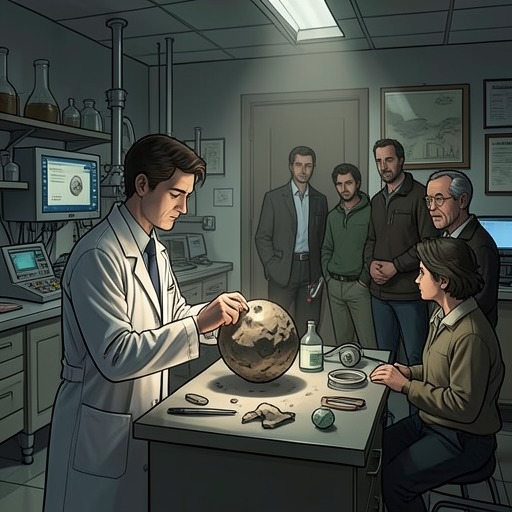
Mangor is introduced not through a formal briefing but through her command of the work site. Rachel sees a small woman in a bright yellow snowsuit, marked with grease, directing the extraction crew and tracking the operation on a clipboard. Her shouted demand that the workers maintain even tension establishes her as exacting and practically involved. The gap between her stature and the authority she exercises over the heavy equipment is part of the scene’s first impression: she is not a symbolic scientific presence at a distance, but the person supervising the difficult physical procedure.
Scientific Work and the Extraction
The extraction rig is an eighteen-foot tripod of composite scaffolding erected over the ice, with winches fixed to steel plates and cables routed over pulleys and down into boreholes. Mangor explains the method to Rachel as she walks her around the tower. The holes had originally been drilled to collect core samples and take X-rays of the meteorite; the team repurposes them as access shafts, lowers heavy screw eyes through them, and fastens those eyes into the buried object. Braided cable and industrial hooks then connect the meteorite to the winches. Raising it is slow—several hours of steady work—but the method brings the object toward the surface without large excavation machinery.
Mangor’s expertise also gives the discovery its chronology. The team had drilled across the glacier to check structural continuity and ensure that the ice was a single, undisturbed slab rather than a surface disrupted by faulting or glacial movement. She concludes that the ice is flawless, with no fault lines or turnover, and classifies the meteorite as a static fall: it has remained untouched in the ice since landing in 1716. She explains that ice cores preserve a frozen geological record, with visible layers that allow the history of the ice to be read. NASA had independently arrived at the same year before the expedition, and Mangor drilled her own cores and ran her own tests to confirm the agency’s work. The account also links 1716 to explorers’ report of a bright fireball over northern Canada, known as the Jungersol Fall after the expedition leader.
Scientific Certainty Under Pressure
Mangor’s confidence rests on two converging bodies of work: her own measurements and NASA’s matching findings. That agreement makes her a powerful witness for the discovery, but it also raises the stakes when the expedition encounters anomalies. When the possibility of saltwater plankton is raised, she rejects the inference that her glacial data might be wrong. She insists that both she and NASA established the glacier’s integrity and that the core data should not be questioned on the basis of what she considers an implausible interpretation.
Rather than leave the disagreement at the level of argument, Mangor collects tools and tests the water herself. She takes a sample from the melt pool with a sterile pipette on a string, places drops in a refractometer, and examines it. The result unsettles her: she curses, shakes the device, and checks again, suspecting that the instrument must be malfunctioning. The moment does not resolve the broader mystery, but it marks a significant change in her position. The scientist who had defended the pristine ice against a disturbing hypothesis has now encountered a measurement she cannot readily reconcile with that defense.
Mangor later uses GPR equipment to examine the water-filled meteorite shaft. After the heat-transfer printer produces a curled paper printout, she carries it to the flare, expecting it to demonstrate that the water contains no saltwater. Instead, the image shows a hazy, humanoid outline floating partway down the shaft. Mangor recognizes the presence of a body in the extraction pit and reacts with alarm. Her discovery converts an abstract dispute about data into evidence of a death at the site, while the printout makes visible something that had remained hidden beneath the ice.
Death and Scientific Legacy
Mangor is killed during the violence surrounding the expedition. In the aftermath, members of the Delta team handle her equipment sled and body while changing their plan to dispose of the investigators’ remains. Because the other three scientists have gone over the edge, the team decides that leaving Mangor’s body alone would invite questions. Delta-One retraces the scientists’ route to recover traces of their presence; Delta-Three and another operative take the sled to the edge of the Milne Ice Shelf and push it into the Arctic Ocean. Mangor’s body and the sled are lost at sea, while the wind erases the team’s tracks.
The account also preserves a different possibility for what will outlast her. In Rachel Sexton’s imagined account of a future recovery, an NRO listening system detects Rachel’s SOS, and rescuers find her, Tolland, and Corky frozen on an iceberg. Rachel’s pocket contains the GPR printout. It is identified as Mangor’s final legacy: the paper can reveal the mysterious insertion tunnel beneath the meteorite, even if the people who uncovered the clue do not survive to explain it. This projected recovery is not a confirmed rescue within the scene; its narrative importance is the possibility that Mangor’s evidence will escape the effort to erase the expedition.
Narrative Role and Significance
Mangor’s arc is shaped by a sharp reversal. At first, she is the expert who resolves an engineering problem and independently corroborates NASA’s dating of the meteorite. When new evidence challenges the expedition’s assumptions, her insistence on testing it herself makes her a witness to the widening discrepancy. The instruments and records associated with her work—the ice cores, water sample, refractometer, and GPR printout—carry the investigation forward, but they do not protect the scientist who operates them.
Her significance therefore lies not only in the discovery she helps validate, but also in the evidence that undermines its apparent certainty. The same careful methods that establish the meteorite’s history give the team a means to expose the hidden shaft, and Mangor’s printout can preserve that revelation after her death. Later, Rachel recounts Mangor’s murder to William Pickering as part of the hard facts behind the expedition’s attack and the survivors’ escape. Mangor remains central to the story as both an independent scientific authority and one of the people whose removal makes the danger surrounding the discovery unmistakable.